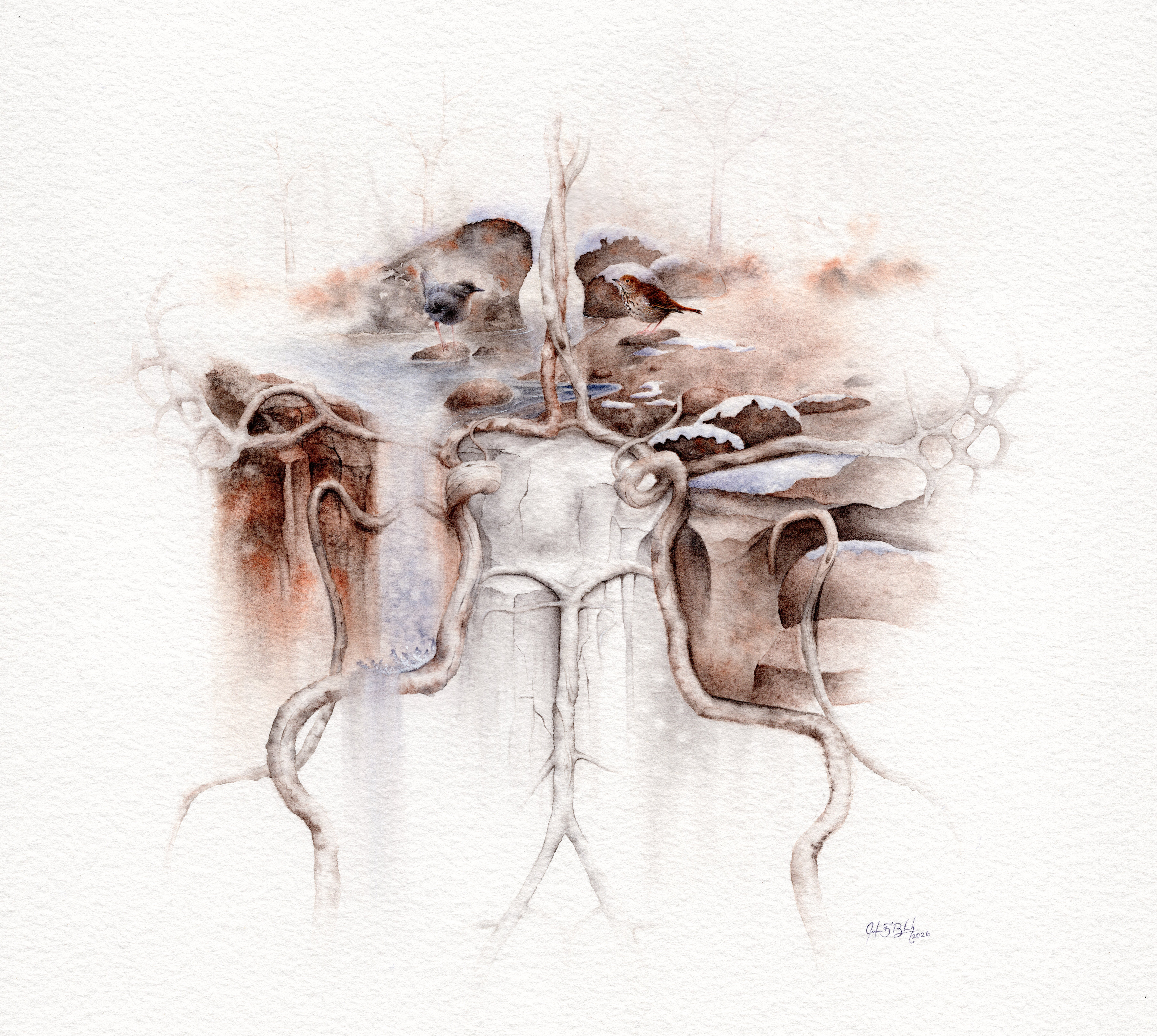
This painting grew from an observation while studying cerebral vasculature. Within the Circle of Willis, I noticed an incidental illusion: the internal carotid and anterior cerebral arteries frame two faces in profile, not unlike Rubin's vase, where anatomy and portrait emerge from the same lines. In clinical encounters, I have since found this observation illustrative of the responsibility to hold a patient's biology and personhood in view simultaneously. This watercolor places this illusion within a winter landscape, where the eyes of the faces are formed by two birds. The American Dipper, which repeatedly changes its perspective while hunting beneath moving water, and the Hermit Thrush, celebrated for one of North America's most ethereal songs, evoke the complementary visuospatial and language functions of the cerebral hemispheres. The following poem is based on a clinical experience and loosely accompanies the piece.
Penumbra
Is she still there? Her family’s question hung heavy on morning rounds
My eyes drifted to her breakfast tray, then the wrinkles in her gown
Thrombi had traveled a tortuous route up the left MCA
And seemed, to those who knew her best, to have stolen her away
My gaze turned inward and I saw her scans, the dark ischemic core
The twisting vessel, brightly lit, halting early on its shore
And I saw the surrounding tissue, injured but not bereft
Of collateral perfusion, preserving what was left
I wondered if in these images, I could yet see her eyes agleam
Darting and perceptive, a dipper hunting in a stream
And hear her neurons’ harmony, ethereal, as a thrush
A music that had once swelled, now playing with a hush
Beyond pure parenchyma, the penumbra’s a prognosis that we weave
Extracted from a sterile field, to describe the person that we see
At once speculative and guarded, we are asked to take the pen
And sketch from vasculature and tissue, a life set to start again
Is she still there? Her family’s question lingered in the air
Yet the answer lived outside her scans, and I did not feel prepared
To use our data to prescribe the door, the family’d next walk through
When her identity would write itself, in experiences built anew